The .io Renewal Creep: $30 Domains Now Renew at $51.80–$73.49
$51.80–$73.49/yr — verified .io renewals the number that matters here
By Stan K.
A .io renewal that ran $30–35 for years now costs $51.80 at Porkbun and $73.49 at 101domain — both verified from official pages in November 2026. Why ccTLD pricing has no ceiling, what the completed Chagos handover actually means for .io (still Active in the IANA root, no retirement date), and the flat $11.81 .com that makes the 10-year comparison brutal: $494 vs $118.
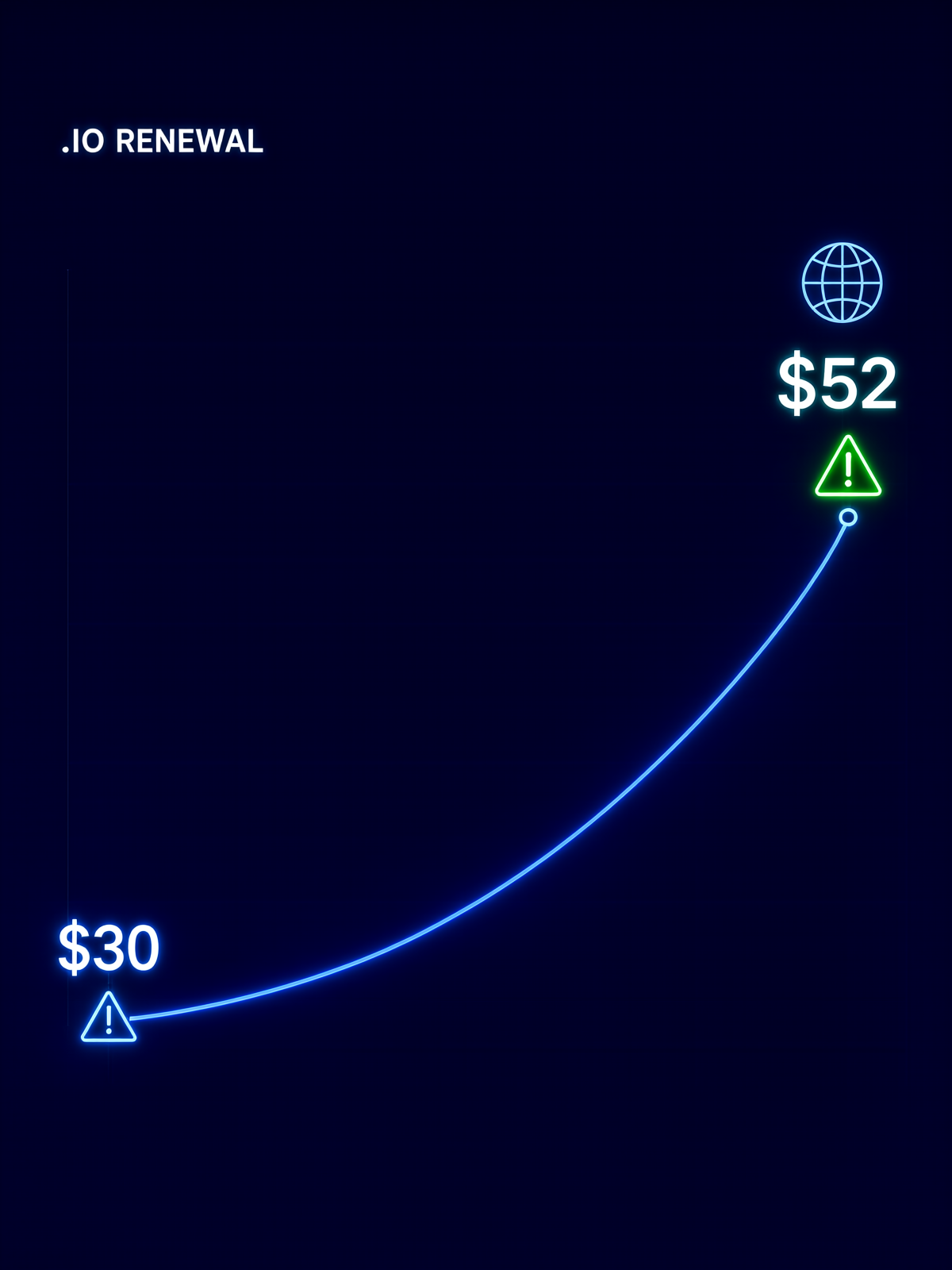
For most of a decade, .io was the indie default — the hacker TLD, priced like a premium but not punishing: $30–35 a year, occasionally less on promotion. That era is over. We pulled the current numbers from official registrar pages in November 2026, and the verified .io renewal corridor now runs from $51.80 (Porkbun) to $73.49 (101domain) a year. That is not a price hike you argue with on social media; it is a structural property of what a ccTLD is.
What .io actually costs, verified
| Registrar | Registration | First-year promo | Renewal |
|---|---|---|---|
| Porkbun | $51.80 | $28.12 | $51.80 |
| 101domain | $69.99 | — | $73.49 |
| Namecheap | — | — | — |
| Cloudflare | at-cost, no markup | — | — (price not machine-readable) |
Two rows have blanks, and the blanks are deliberate. Namecheap’s pricing pages returned 404/403 to every probe we made — no verified number, so no number. Cloudflare’s registrar sells at cost with zero markup (that promise is documented), but its actual prices load from an API behind an access challenge; we could not machine-verify a .io figure, so we do not print one. We publish facts. A cell with ”—” is a fact too: it means the vendor does not publish that figure in a channel we can check.
Note the promo row, because it is the part people remember: Porkbun’s first year at $28.12 is real, and the renewal at $51.80 is 1.8× it. The first invoice is marketing; the renewal is the price.
Why the number only goes up
.io is the country-code TLD of the British Indian Ocean Territory (ISO 3166 code IO). A ccTLD belongs to a registry that is ultimately answerable to a territory, not to the contract structure that disciplines .com pricing at the ICANN layer. There is no published price cap on a ccTLD renewal: the registry sets a wholesale price, registrars add their margin, and the only vote you get is whether to pay. When a registry moves its wholesale price, every .io bill in the market moves at once.
And wholesale prices are moving. Squarespace states it publicly while raising its own domain renewals: “registries raised wholesale prices” and “Squarespace is increasing renewals for .xyz, .com, .net, and .org domains.” If the contractually-tamed generic TLDs are stepping up, the untamed country codes are not standing still. The specific wholesale numbers behind .io are not published in any official channel we could verify — so we won’t invent them — but the direction is documented, and the retail corridor above is the verified consequence.
The Chagos question — settled, and smaller than the headlines
The geopolitical backstory is real, and it is usually oversold in both directions. The .io code maps to the Chagos Archipelago, and the United Kingdom transferred sovereignty over the islands to Mauritius under the 2024–2025 agreement, including a 99-year lease on Diego Garcia. A ccTLD whose territory changes hands is a genuine long-term governance question: the ISO code that anchors the TLD no longer matches the sovereignty on the map, and there is no playbook with a date attached.
What we can verify as of November 2026: .io remains Active and delegated in the IANA root database, with the Internet Computer Bureau / Sure (Diego Garcia) Ltd listed as the sponsoring organization — an entry maintained and updated into late 2026. No retirement or transition date exists on any official page. The honest framing is “long-term governance risk with no scheduled outcome.” Not “the TLD is dying” — nobody official has said that. Not “nothing happened” — the territory’s sovereignty did change hands. If you build a decade-long brand on .io, you carry a tail risk that a .com owner does not. That is the entire sentence; anything louder is clickbait.
Chagos sovereignty transfer: completed (UK to Mauritius, 2024–2025, 99-year Diego Garcia lease). .io in the IANA root: Active, delegated, sponsoring organization Internet Computer Bureau / Sure (Diego Garcia) Ltd. Retirement date: none published anywhere official. Risk class: long-term governance, not imminent.
The comparison that ends the debate
Ten years of a domain name, at verified prices, no promos assumed after year one:
| Name | Year 1 | Renewals (years 2–10) | 10-year total |
|---|---|---|---|
| .com at Porkbun | $11.81 (or $10.81 with the standing −$1 coupon) | 9 × $11.81 | $118.10 |
| .io at Porkbun | $28.12 (promo) | 9 × $51.80 | $494.32 |
| .io at 101domain | $69.99 | 9 × $73.49 | $731.40 |
Same decade, 4–6× the price. The .io premium buys a shorter name and a developer-flavored signal. It does not buy stability — it buys exposure to an uncapped registry plus the governance tail risk described above. The .com row carries its own asterisk (registry wholesale can rise there too, and flat-price registrars pass it through), but its verified present is one flat number — $11.81 for registration, renewal and transfer alike — against a .io corridor that starts at $51.80 and has no ceiling.
If you already own a .io
Three sober moves, no panic required:
- Make the renewal a conscious decision. Know your number ($51.80–$73.49 corridor), calendar it, and decide annually whether the name still earns it. The trap is treating a $51.80+ bill as background noise on a project you abandoned.
- Do not read this as a shutdown signal. Active in IANA, no retirement date, a maintained root entry. Anyone telling you to migrate “before .io is deleted” is selling urgency that no official page supports.
- Price the exit honestly. You cannot transfer a .io into a .com; a rebrand means a new registration, redirects, and SEO work. Compare that one-time cost against $466–$661 of remaining renewals over nine years — sometimes staying is still correct.
The full registrar-by-registrar table — including the registrars whose numbers we could not verify, marked as such — is in the Domains hub. For the other end of this trade: why a .com is all most builders need, and the expiration and transfer traps that apply to every TLD in this article.